The quick decision path
Final calls belong to the mitigation contractor and adjuster, but these are the factors they weigh.
- IfClean supply-line or sprinkler water, extracted quickly, tiles still flat and bondedThenDrying in place is often possible, followed by cleaning and a check that the adhesive held.
- IfTiles are curling, the backing is delaminating, or the adhesive has let goThenReplacement is the usual outcome, even if the face looks fine.
- IfWater came from a toilet overflow, drain backup or anything with sewageThenPorous flooring in the affected area is generally removed and the subfloor cleaned and treated.
- IfWater sat for several days before anyone found itThenEven clean water can degrade; expect contamination concerns and likely removal.
- IfOnly some tiles in a large area are affectedThenAsk about matching. Replacing a patch with a newer dye lot can leave a visible difference that becomes a separate dispute.
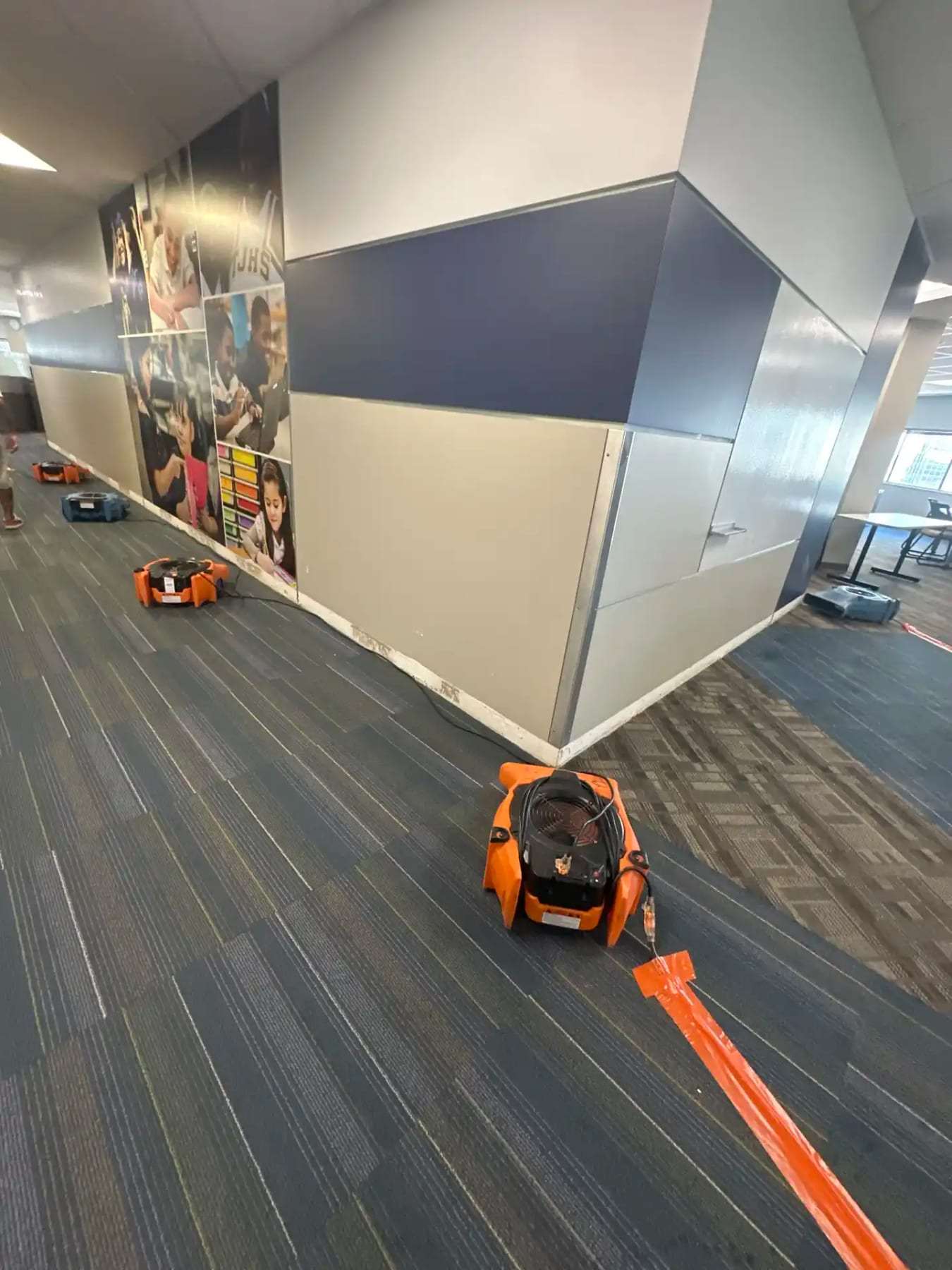
Air movers drying patterned carpet along an office corridor. A general example of this kind of work, not a photo of a particular home, business or job.
Factors that change the outcome
- Factor
- Water source
- Favors drying
- Clean supply line
- Favors replacement
- Drain, sewer, or long-standing water
- Factor
- Time wet
- Favors drying
- Extracted within hours
- Favors replacement
- Wet for days
- Factor
- Backing
- Favors drying
- Stable, intact backing
- Favors replacement
- Delaminating or swelling backing
- Factor
- Install method
- Favors drying
- Releasable adhesive that re-tacks
- Favors replacement
- Adhesive that has emulsified or failed
- Factor
- Subfloor
- Favors drying
- Sealed concrete that dries readily
- Favors replacement
- Concrete with high moisture or old adhesives under the tile
- Factor
- Availability
- Favors drying
- Same style still in stock
- Favors replacement
- Discontinued pattern in a large field
Raised access floors are a special case
Some downtown offices, trading floors and data rooms use raised access floors, with panels set on pedestals and cabling or air distribution underneath. Water entering that space spreads widely and out of sight. The panels must be lifted to extract it, and the cavity treated like a ceiling plenum: dried, checked for wet cabling, and verified before panels go back.
If the underfloor space is used for air distribution, wet conditions there can move odor and moisture into the occupied space. Make sure the HVAC vendor is part of the plan.
Older floors may also hide older materials. Before cutting or grinding flooring in a pre-1980s building, ask whether the floor tile, mastic or leveling compound below has been tested for asbestos.
Before you approve drying in place
- Confirm the water source and category in writing.
- Ask for moisture readings in the concrete under the tile, not just the tile itself.
- Pull a few tiles in the wettest area to check the adhesive and the slab.
- Agree on how the floor will be verified dry and what happens if tiles later curl.
- Keep a few spare tiles from attic stock, if any, for matching.
Common questions
Can carpet tile be pulled up, dried and reinstalled?
Sometimes, if the tiles are numbered and kept flat and clean while the slab dries. It works better with releasable adhesive and clean water.
General information for Downtown Denver, not a quote or professional advice. In an emergency, call 911.